A brownstone walkup has one front door and four households behind it — and no doorman, no mailroom, and nowhere for a driver to put anything. Here's what actually works when the front door isn't only yours.
Key takeaways
- New York City DOT cites more than 90,000 packages reported stolen or lost in transit every day — and 80% of NYC households get at least one package a week.
- Walkups are exposed by architecture, not neglect: no staffed lobby, no package room, and a stoop that's fully visible from the sidewalk.
- The city's own answer — free public lockers — works, but it's a walk, and only 22 sites exist so far.
- A small building's real advantage: one front door means one locker and one $4.99/month plan cover every unit — with separate access and separate alerts for each.
The short answer
In a building with no doorman, the only fixes that hold are the ones that give the driver a locked place to put the box at your door. Buzzer access, in-vestibule drops, and cameras all leave the package sitting somewhere anyone can reach. A locked receptacle at the entry solves it for every unit behind that door at once.
Why a walkup is harder than a house
Sources: NYC DOT1 · SafeWise2 · Stickle via Pinkerton.3
A single-family house has one household and one door, and the two match. A walkup breaks that. Four units sit behind one entrance, and the building has none of the infrastructure a large doorman building would — no staffed desk, no package room, no receiving policy. What it has instead is a stoop.
So the driver does the only thing available: buzzes, gets no answer, and leaves the box on the steps or just inside an unlocked vestibule. Both are exposed. A stoop is elevated and street-facing by design — the architecture that makes brownstones beautiful also puts every delivery on display. In criminologist Dr. Ben Stickle's video analysis, 98% of stolen packages were visible from the street, and homes within 25 feet of the road accounted for 61% of thefts.3 A stoop is, by construction, within 25 feet of the road.
Then multiply it. Four units ordering independently means four times the deliveries through one exposed entry, and four times the chances that a box sits there through an afternoon.
What people try, and where each one stops
| Approach | Stops theft? | Where it breaks |
|---|---|---|
| Buzz-in to the vestibule | No | Anyone buzzed in after reaches the pile |
| Public delivery locker | Yes | It's a walk, on the city's schedule |
| Ship to your office | Yes | Weekdays only, small boxes only |
| Entry camera | No | Documents the theft; the box is still gone |
| Locked box at the entry | Yes | Needs somewhere to anchor it |
Ranked by whether the package is ever left where a stranger can pick it up.
The public-locker option deserves real credit. LockerNYC is free, secure, and genuinely works — the city runs 22 sites across Manhattan, Brooklyn, and Queens, with more than 10,000 reservations logged and expansion planned for Sunset Park and Jackson Heights. More than 70% of users signed up specifically to reduce theft risk.1 If there's one near you, use it. But 22 sites across three boroughs means most buildings aren't near one, and every delivery becomes a trip you schedule around.
The advantage a small building actually has
Here's the thing a four-unit walkup has that a house doesn't: the cost of solving this is divided by four.
A doorman building solves package theft with a staffed desk and a dedicated room. A house solves it with one box for one household. A walkup falls between the two — too small for staff, too shared for a single-household fix. But the entry that creates the problem also concentrates the solution: one secure receptacle at that door covers every unit behind it, because every unit's packages arrive at the same place anyway.
The thing that makes this work rather than turning into a mess is access control. A shared box is only useful if it isn't actually shared — if each unit has its own code, sees its own alerts, and never has to coordinate with anyone about a delivery. Infrastructure at the door, privacy per unit.
How hyve fits a walkup
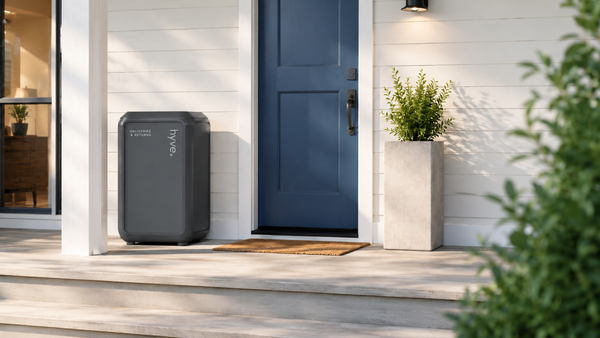
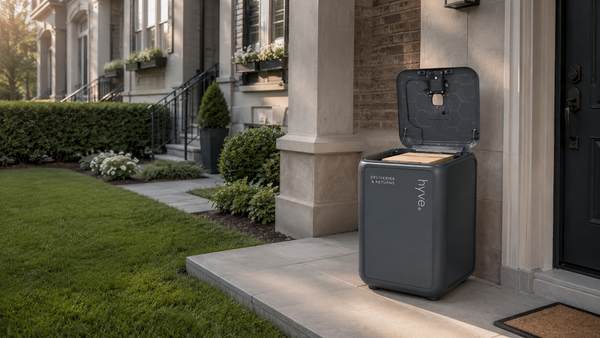
hyve is a smart delivery locker built for the front of a building. Carriers get their own vendor PINs, so UPS, FedEx, USPS, and Amazon can each open it — and the app shows who opened your box and when, in real time. Residents get their own access and their own alerts through the app's user permissions, so a delivery for one unit is that unit's business alone.
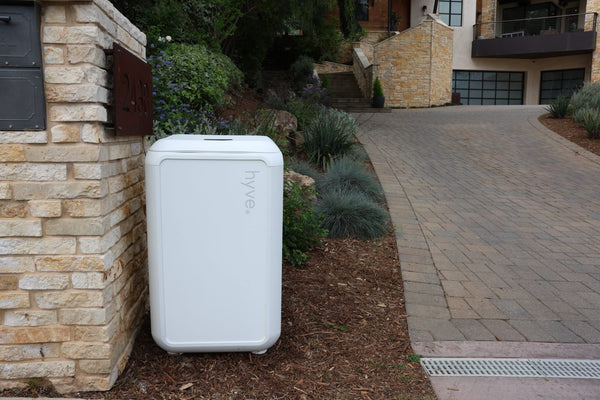
It's sized for a building rather than a single order: 7.4 cubic feet, enough for 80% of Amazon's package configurations and several days of deliveries at once. It stands 32 inches tall, and the universal security tether anchors it to a gate, post, railing, or fence — which is what a stoop, an iron fence, or a garden-level gate actually offers. No wiring, no electrician: it runs on AA batteries with solar trickle and USB-C backup, and the electronics are IP65-rated for weather.
Here's the part that changes the math. The locker is $297, one time, and the building runs on one $4.99/month plan — a single subscription for the locker, not one per unit. Across four units that's roughly $74 each up front and a little over a dollar a month per household, for the thing that ends the problem entirely.
One door, one box
Delivered. And off your mind.
A locked box at the entry, separate access for every unit, and an alert the moment your package is secured.
See how hyve worksQuestions, answered
Can more than one apartment use the same delivery locker?
Yes. Access is managed per person in the app, so each unit gets its own code and its own alerts rather than a single shared password. For a two- to four-unit building where every delivery already arrives at the same entrance, one locker at that entrance covers all of them — on one $4.99/month plan for the building, not a separate subscription per unit.
Where do you put a locker on a brownstone?
Anywhere at the entry with something solid to anchor to — a stoop railing, an iron fence, a gate, or a garden-level entry. The universal security tether is what does the work; it doesn't need to be bolted into the building, which matters if you rent.
Is package theft worse in New York than elsewhere?
By rate, yes. SafeWise's 2025 report puts New York at 965 thefts per 1,000 households, the highest in the country and well above the U.S. average of 665.2 Density is the reason: more deliveries per block, more foot traffic, and more entries where a package can sit unattended.
What about leaving packages in the vestibule?
It's better than the stoop and still not secure. A vestibule door gets buzzed open all day — for other carriers, for menus, for anyone who tries enough buzzers. An unlocked interior space isn't a locked one; it just moves the pile out of the rain.
Keep reading
Sources
- NYC Department of Transportation — LockerNYC milestone announcement (90,000 daily figure cited to The New York Times)
- SafeWise — 2025 U.S. Package Theft Report
- Pinkerton — Dr. Ben Stickle video analysis
General information as of August 2026. Locker placement in a shared building may be subject to your lease or building rules.