Package theft has gone from a crime of opportunity to an organized operation. New state laws, task forces, and arrests are changing the fight — but the porch is still where it's won or lost.
Key takeaways
- Package theft cost the U.S. an estimated $37 billion in 2024–2025 — $14.9B to consumers and roughly $22B to retailers.
- An estimated 104 million packages were stolen — roughly 248,000 doorsteps hit every single day.
- California, New York, and Texas lose the most dollars; New York and Pennsylvania have the highest per-household theft rates.
- 11 states and D.C. now have laws that specifically address package theft, most elevating it to a felony under certain conditions.
- 98% of stolen packages were visible from the street — the single biggest, and most fixable, risk factor.
Americans aren't just losing packages anymore
Package theft has evolved. What was once an occasional crime of opportunity — a passerby grabbing a box off a step — has become increasingly organized across much of the country. Law enforcement agencies are now investigating coordinated porch pirate rings that follow delivery trucks, target neighborhoods during peak delivery hours, and resell stolen merchandise online within hours.
The numbers are hard to ignore. According to SafeWise's 2025 U.S. Package Theft Report, porch pirates cost American consumers an estimated $14.9 billion over the past year — and once retailer losses from refunds and replacements are counted, the total economic impact climbs to roughly $37 billion.1 An estimated 104 million packages were swiped from doorsteps nationwide — about 248,000 every single day.
To put that in perspective: package theft is now among the most commonly experienced crimes in America.2 And it's getting more expensive. The average stolen package is now worth $143, up 8% in a year, meaning thieves are walking away with more value from every hit.1
Source: SafeWise 2025 U.S. Package Theft Report (reflecting Nov 2024–Oct 2025).1
For homeowners, that raises the question almost nobody is answering:
What are states actually doing to stop it?
Why organized porch pirate rings are different
Not every stolen package is the work of a syndicate — researchers caution that much theft is still opportunistic.8 But the organized end of the spectrum is real, and it's growing. Rather than grabbing a random box on a walk, many crews now operate like a business:
- Follow Amazon, UPS, and FedEx trucks and strike within minutes of drop-off
- Monitor entire neighborhoods during peak delivery hours
- Use multiple vehicles, runners, and — in the worst cases — insider tracking data
- Resell stolen goods through online marketplaces and bulk wholesalers
Law enforcement increasingly treats these operations as organized retail crime rather than isolated theft. The clearest example landed in late 2025.
Case file · Suffolk County, NY
"For two years, this alleged porch pirate ring plagued our community and built a criminal enterprise on the backs of Suffolk families and businesses."
In October 2025, prosecutors indicted 14 people on 50 felony charges — including enterprise corruption — for a ring that used insider FedEx tracking data to steal high-value electronics within minutes of delivery, from North Babylon to Montauk. Search warrants recovered 200+ new cellphones and about $100,000 in cash. The investigation covered thefts between October 2023 and February 2025.4
— District Attorney Raymond A. Tierney, Suffolk County
Separate reporting found the crew sometimes didn't even wait for delivery — surveillance caught them approaching a driver mid-street for a box of tablets.5 This is exactly the shift that's pushing statehouses to act.

States are toughening their laws
Federal mail-theft law (18 U.S.C. § 1708) only reaches items in USPS custody — it doesn't cover a FedEx or Amazon box sitting on your step.11 So states have stepped in. Since Texas passed the first dedicated porch-piracy law in 2019, more than a dozen states have followed with statutes that specifically target package theft or fold it into organized-retail-crime enforcement.8
Texas
The first state to act. House Bill 37 (2019) created a dedicated mail-theft offense that scales with how many addresses a crew hits: fewer than 10 is a Class A misdemeanor, 10–29 is a state-jail felony, and 30 or more is a third-degree felony carrying two to ten years. Penalties increase further when the victims are elderly or disabled.6
Florida
2024's House Bill 549 made retail theft committed by five or more people a third-degree felony, and using social media to coordinate a theft a second-degree felony. For porch theft specifically: property worth under $40 is a first-degree misdemeanor, while $40 or more — or a repeat offense — is a third-degree felony punishable by up to five years.7
California
Proposition 36, approved by voters in November 2024, made theft under $950 a felony for anyone with two or more prior theft convictions, and lets prosecutors aggregate the value of separate thefts to clear the felony threshold. It also added sentence enhancements for property crimes committed by three or more people.10
New York
The Suffolk County indictment shows how prosecutors are using existing enterprise-corruption statutes against theft rings — a charge that carries far heavier exposure than simple larceny.4 SafeWise data puts New York among the states with the highest share of residents reporting theft.2
The national picture
As of 2025, 11 states and the District of Columbia have laws that specifically address package theft, most elevating it to a felony under certain conditions. Lawmakers increasingly treat porch piracy as organized property crime — closer to burglary than to a petty nuisance.1
How the toughest statutes compare
Texas wrote the template in 2019 and Florida sharpened it in 2024; most of what's passed since borrows from one or the other. Here's what's actually on the books.
| State | Status | What the law does |
|---|---|---|
| Texas | Enacted 2019 | HB 37 — first in the nation; charge scales by number of addresses hit |
| Florida | Enacted 2024 | HB 549 — porch theft of $40+ or a repeat offense is a third-degree felony |
| California | Expanded 2024 | Prop 36 — theft aggregation and repeat-offender felonies |
| Pennsylvania | Enacted 2024 | Package theft elevated from misdemeanor to felony |
| Kentucky | Enacted 2022 | "Porch Pirate Bill" — Class D felony |
| Arkansas | Enacted 2021 | Dedicated package-theft felony |
| Tennessee | Enacted 2021 | Dedicated package-theft felony |
| Alabama | Proposed 2025 | Reintroduced porch-piracy felony bill |
| New York | Proposed 2025 | A3405 — would create multiple degrees of package theft |
Charges and sentences vary with the value stolen, prior offenses, and whether the theft is charged as part of an organized operation. This is general information, not legal advice.6,7,10
It's worth a note of honesty: some criminologists argue these laws sweep up opportunists more than kingpins, and that reliable data on how "organized" the average theft really is remains thin.8 The tougher statutes matter — but no homeowner should wait on a courtroom to protect their doorstep. Which is why prevention is the other half of this story.
Top 10 states most impacted by package theft
Ranked by total consumer losses in the SafeWise 2025 U.S. Package Theft Report — built from FBI larceny data and a 7,500-person national survey. California tops the list at over $1.5 billion, but the per-household story below is very different.
Total consumer losses to porch pirates in the past 12 months.1
The 10 states broken out
| # | State | Consumer losses | Thefts / day | Per 1,000 homes |
|---|---|---|---|---|
| 1 | California | $1.55B | 32,396 | 837 |
| 2 | New York | $1.29B | 21,447 | 965 |
| 3 | Texas | $1.19B | 16,469 | 515 |
| 4 | Florida | $984M | 17,583 | 686 |
| 5 | Pennsylvania | $662M | 14,332 | 944 |
| 6 | Michigan | $480M | 8,940 | 772 |
| 7 | Ohio | $470M | 8,619 | 622 |
| 8 | Georgia | $468M | 7,865 | 665 |
| 9 | Illinois | $402M | 9,837 | 686 |
| 10 | North Carolina | $369M | 7,063 | 558 |
"Per 1,000 homes" is package-theft incidents per 1,000 households; the U.S. average is 665. Amber and red flag states above that line.1
Worth knowing: total dollars largely track population. Ranked instead by incidents per 1,000 households, the picture shifts sharply — New York (965) and Pennsylvania (944) lead the nation, both far above the U.S. average of 665, even though neither tops the dollar chart.1
Why cameras alone aren't solving porch piracy
Doorbell cameras changed how homeowners see package theft. They haven't stopped it. In most cases a camera provides evidence after the theft has already happened — and organized porch pirates show up in hoodies and masks, arrive in cars with covered plates, and are gone before the clip finishes uploading.5
of stolen packages were visible from the street in criminologist Dr. Ben Stickle's video analysis — and homes within 25 feet of the road accounted for 61% of observed thefts. Visibility, not the absence of a camera, is the vulnerability porch pirates exploit most.9

Fewer than 1 in 4 victims even report the theft to police, and only a tiny fraction of cases end in a conviction.3 That's why more homeowners are pairing cameras with physical protection — a package delivery box for outside or a package locker for front door that keeps deliveries from ever sitting exposed. Instead of documenting a crime, the goal is removing the opportunity altogether.
Doorbell camera vs. smart package locker
| Capability | Doorbell camera | Smart package locker |
|---|---|---|
| Records the theft | Yes | Yes |
| Prevents the theft | No | Yes |
| Works with every carrier | Yes | Yes |
| Locks package on delivery | No | Yes |
| Alerts you when secured | Yes | Yes |
| Handles outbound returns | No | Yes |
A camera tells you a theft happened. A locked box makes sure it doesn't.
How a locked box changes the math
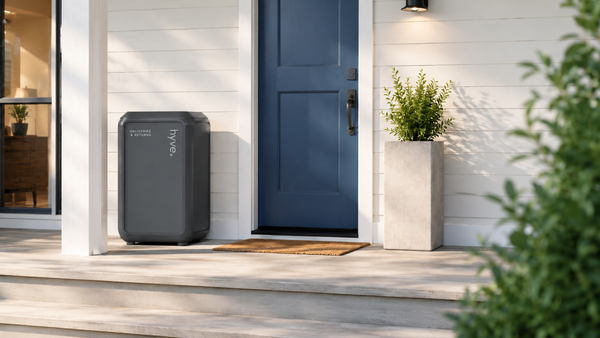
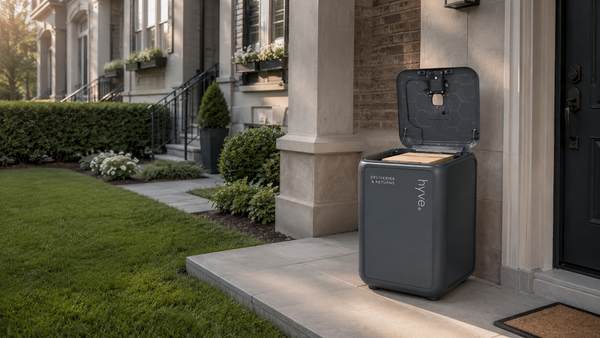
Every porch pirate — opportunist or professional — depends on one thing: a package sitting out in the open. Take that away and the crime has nowhere to happen. That's the entire logic behind a package delivery box for outside. The driver drops the delivery inside, the lid locks, and a universal security tether anchors the box to your door, gate, post, or fence so it can't simply be carried off.
The newest generation goes further. A smart package locker for front door gives each carrier its own vendor PIN — so UPS, FedEx, USPS, and Amazon can all open it — and identity-based alerts show you exactly who accessed it and when. With hyve, the same locker holds your outbound returns until pickup comes to you. One box. Every carrier. Both directions.

Stop the opportunity
A package can't be stolen if it's never left exposed.
hyve is the package delivery box for outside that works with every carrier from day one — deliveries in, returns out, and a buzz to your phone the second your package is locked safely inside.
See how hyve worksFrequently asked questions
What is a porch pirate?
A porch pirate is someone who steals packages left outside a home after delivery — usually right off the porch, steps, or front door.
Are porch pirate rings real?
Yes. Law enforcement agencies across the U.S. increasingly investigate coordinated crews that follow delivery vehicles, use insider tracking data, and resell stolen goods. In October 2025, Suffolk County, NY prosecutors indicted 14 people in a two-year porch pirate enterprise that stole more than 200 phones.
What states have the worst porch pirate problem?
By total value lost, SafeWise's 2025 report ranks California ($1.55B), New York ($1.29B), Texas ($1.19B), Florida ($984M), and Pennsylvania ($662M) as the five hardest-hit states. Ranked by incidents per household, New York (965 per 1,000) and Pennsylvania (944) top the list.
Is package theft a felony?
It depends on the state and the circumstances. As of 2025, 11 states and the District of Columbia have laws that specifically address package theft. Texas, Kentucky, Arkansas, Tennessee, and Pennsylvania have made it a felony under certain conditions; Florida elevates porch theft of $40 or more, or a repeat offense, to a third-degree felony; and California lets prosecutors aggregate thefts or charge repeat offenders with felonies. In most other states it's charged as larceny, where the value determines severity.
What is the best way to prevent package theft?
Layer your defenses: delivery notifications, signature-required delivery, security cameras, delivery instructions, and physical protection like a secure package locker for front door or a package delivery box for outside that locks packages away the moment they arrive.
Do package delivery boxes for outside actually work?
Yes. A locked package delivery box for outside removes the one thing every porch pirate depends on — an exposed box on the step. Instead of documenting a theft after the fact, the package is secured the instant it's delivered.
The future of package security
As ecommerce keeps growing, package theft is graduating from a nuisance into a genuine public-safety and organized-retail-crime issue. States are answering with stronger laws, specialized task forces, and high-profile prosecutions — and that pressure is real progress. But enforcement always arrives after the fact. Homeowners remain the first line of defense.
The reality is simple: a package can't be stolen if it was never left exposed in the first place. That's why more homeowners are moving beyond simply watching deliveries happen — and choosing a package delivery box for outside or a package locker for front door that secures every package the moment it arrives.
Keep reading
Sources & references
- SafeWise — 2025 U.S. Package Theft Report and Worst Metro Cities for Porch Pirates.
- SafeWise — Package Theft and Cybercrime Are Now the Most Common Crimes in America.
- Security.org — 2025 Package Theft Report and Statistics.
- Suffolk County District Attorney — Ringleader and 13 Others Indicted for Sophisticated "Porch Pirate" Criminal Enterprise (Oct. 2025).
- Fox News — Sophisticated porch pirate ring hacked shipment tracking info to steal hundreds of phones (Nov. 2025).
- The Texas Tribune — Stolen package? The culprit could get jail time in Texas (HB 37, 2019).
- Executive Office of the Governor of Florida — Legislation to Eliminate Retail Theft and Porch Piracy (HB 549, 2024).
- Type Investigations & The Guardian — When Porch Piracy Became a Felony.
- Pinkerton — What's Behind Holiday Season Porch Package Theft (Dr. Ben Stickle video analysis, Middle Tennessee State University).
- Ballotpedia — California Proposition 36 (2024).
- USPS Office of Inspector General — Package Theft in the United States.
This article is for general information and reflects reporting as of August 2026; it is not legal advice.