Every major shift in commerce creates new infrastructure. Railroads created freight terminals. Highways created distribution centers. Ecommerce created fulfillment centers. But something else has quietly changed over the last decade: commerce stopped moving in one direction.
We don't just buy products anymore. We return them, resell them, rent them, repair them, exchange them, and donate them. Commerce became two-way. And the backward flow is no longer a rounding error — it's one of the largest and fastest-growing lanes in the economy. U.S. shoppers are on track to send back roughly $850 billion in merchandise in 2025, about 15.8% of everything they buy, and closer to 19.3% of everything bought online. The global market that exists purely to move goods in reverse — returns, resale, repair, recycling — is already worth $883 billion and is projected to reach $3.18 trillion by 2033. Yet our homes are still built around a one-way assumption: that packages simply arrive.

A new category
Across retail, logistics, and government, organizations are investing in secure handoff locations. Apartment package rooms, parcel lockers, retail pickup counters, and carrier hubs all serve the same purpose: allowing physical goods to change hands without two people meeting at the same time. They're no longer just lockers. They're exchange points.
The USPS signal
The launch of USPS Local XChange in July 2026 is one of the clearest signals that this category is evolving. Sellers can leave marketplace purchases in USPS Smart Lockers — already installed at roughly 700 post office locations — for nearby buyers, who retrieve them later with a secure QR code for $5.51 a package. The Postal Service is effectively monetizing secure exchange rather than transportation alone. That shift validates a broader trend: delivery storage is becoming exchange infrastructure.
USPS is no longer just moving packages. It's renting out the moment a package changes hands.
Why it matters
Consumers optimize for time, not logistics. Public lockers reduce theft and improve efficiency, but they often require an additional trip — Local XChange only works if a locker sits within 50 miles of the seller, and the buyer still has to drive to it inside a five-day window. Every stop, parking lot, and pickup window adds friction. It helps explain why only 6% of U.S. shoppers say they prefer picking up from a parcel locker, half the global rate. Convenience isn't measured by where the package sits. It's measured by how little effort the consumer must invest to complete the transaction.
The home is the missing node
Think about where commerce actually happens. Deliveries arrive at home. Returns begin at home. Marketplace sales are packaged at home — and resale is booming, with the U.S. secondhand market on pace to hit $306 billion by 2030 and 93% of Americans having bought something secondhand in the past year. Donations leave from home. Repairs start and finish at home. Even the theft problem is a home problem: porch pirates are expected to lift 37 million packages worth $8.2 billion this year, with one in four Americans having had a package stolen. The home has quietly become one of the most important logistics nodes in modern commerce — yet it has almost no purpose-built infrastructure.
By the numbers
| Figure | What it means | Source |
|---|---|---|
| $850B | U.S. retail returns projected in 2025 (15.8% of sales; 19.3% online) | NRF & Happy Returns |
| $3.18T | Projected global reverse logistics market by 2033, up from $883B in 2025 (17.4% CAGR) | Grand View Research |
| $306B | U.S. resale / recommerce market by 2030; 93% bought secondhand last year | Chain Store Age / OfferUp |
| 37M | Packages expected stolen from doorsteps this year — $8.2B in losses, avg. $222 each | Security.org |
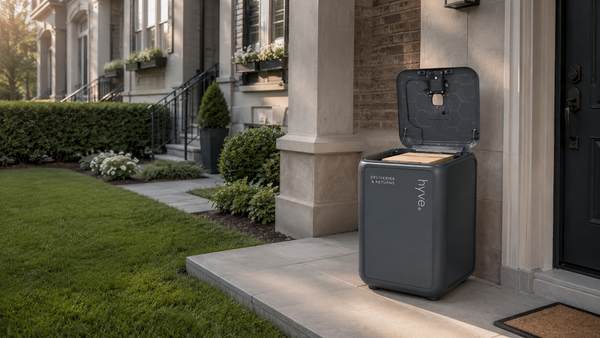
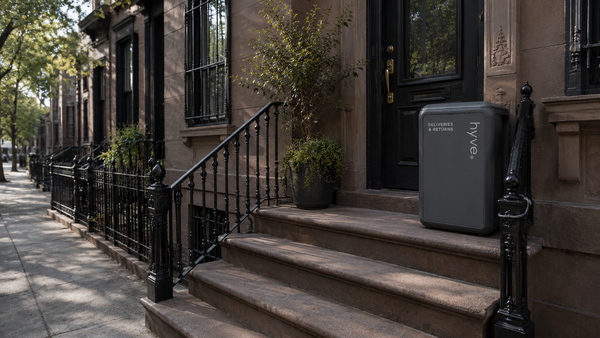
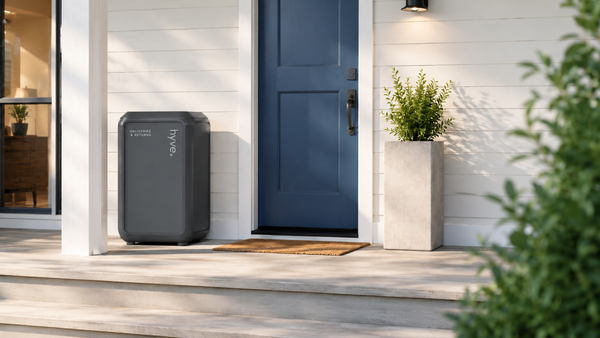
The real opportunity isn't another box. It's an infrastructure layer that lets carriers, retailers, marketplaces, neighbors, service providers, and consumers exchange goods through the home with the same simplicity that today's logistics networks move goods between warehouses. That's the infrastructure hyve is building.
Why hyve is building more than a smart locker
Today, most people know hyve as a secure place to receive deliveries. But that's only the first layer. We're building the operating infrastructure that allows commerce to move both directions through the home.
Today that includes secure deliveries. It also includes scheduled return pickups: in select neighborhoods across Los Angeles and Seattle, customers can leave eligible retailer returns securely at home for collection on designated service days instead of driving to a shipping location. Our logistics partners complete those pickups using dedicated local delivery providers — bringing reverse logistics directly to the doorstep, for single-family homes and apartment communities alike.
That reach matters. The same infrastructure is designed to serve apartment communities as well as single-family homes, because commerce doesn't stop at the front gate. It happens wherever people live.
Tomorrow, that same network can support resale transactions, marketplace exchanges, rental returns, repair logistics, product recycling, neighborhood commerce — and services that haven't even been imagined yet.
The locker isn't the platform. It's the endpoint. The infrastructure is everything connected around it.
Conclusion
For years the logistics industry has asked, "Where should people go to exchange packages?" Public lockers, retail stores, and postal facilities are all valid answers. But they begin with the same assumption — that the consumer should travel to the exchange. We believe the better question is, "Why should people have to go anywhere at all?"
The first generation of ecommerce built infrastructure to move packages between manufacturers, warehouses, fulfillment centers, and consumers. The next generation will connect the consumer back into that network.
We believe every home will become an active node in modern commerce — not simply a destination where packages arrive, but a place where goods are delivered, returned, exchanged, repaired, resold, and redistributed. That's the infrastructure hyve is building.
Because the future of commerce doesn't end at the front door. It begins there.
Sources
- National Retail Federation & Happy Returns, "Consumers Expected to Return Nearly $850 Billion in Merchandise in 2025" (2025).
- Grand View Research, Reverse Logistics Market Size, Share & Trends Report (2025).
- Supply Chain Dive, "USPS launches smart locker service for local transactions" (2026).
- Chain Store Age, "U.S. resale market to reach $306 billion by 2030" (2025).
- Security.org, 2025 Package Theft Annual Report.