The delivery network ends at the property line. The last two feet have always been the customer's problem to solve.
The porch gap is the disconnect between successfully transporting a package to a home and securely transferring that package into the customer's custody.

What is the porch gap?
Boston Dynamics recently gave a name to one of logistics' oldest problems. Testing its Spot robot as a last-mile courier, the company described the challenge of bridging the "porch gap" — the last 50 feet between a delivery van and a front door. Legs, they argue, can handle the curbs, stairs, gravel, and snow where drones and wheeled robots stall.
It's a useful phrase. But it describes only half the gap. Getting a box to the doorstep is a transportation problem. What happens after it lands — an unattended parcel sitting in plain view until someone happens to bring it inside — is a custody problem. And custody is the part no robot, camera, or tracking scan has actually solved.
At hyve, we spend all day on that second half. So let's extend the conversation: reaching the porch does not equal secure receipt. Here's why the gap persists, and what it takes to close it.
Why the last 50 feet are difficult for carriers
The final leg looks trivial on a map — it's the shortest distance in the whole supply chain — but it carries the highest cost per package. Consolidated freight moves thousands of boxes to one dock. The last mile scatters single parcels across dispersed homes, each with its own driveway, gate, dog, and porch layout.
| Share of total shipping cost consumed by the last mile | |
|---|---|
| 2018 | 41% |
| 2024 | 53% |
| U.S. last-mile market, 2025 | $201B |
| U.S. delivery-cost rise, 2024 to 2025 | +12% |
Source: eMarketer / FarEye, 2026.
Carriers have poured automation into every stretch they control — sortation, routing, hubs. The porch is the one place they don't control. So the moment a driver sets the box down, the network's job ends and its liability transfers. That hand-off is the seam the whole industry is now trying to close.
Why reaching the doorstep does not complete the customer experience
For the person who ordered the package, the journey isn't finished when the van pulls away. It's finished when the item is safely in their hands. Between those two moments sits an unattended box on an exposed surface — and that window is exactly where the experience breaks.
The scale of that breakage is no longer a rounding error. It's a recurring cost of shopping online.
- 104 million packages stolen in the U.S. in a year
- $37 billion estimated cost to households
- About 1 in 4 adults hit in the past year
- 4% of stolen packages ever recovered
Sources: SafeWise 2025 Package Theft Report; Forbes Home.
What "delivered" actually confirms
Here is the quiet truth behind that reassuring notification. A "delivered" status is a carrier's scan event — a record that the network handed the parcel off to a location. It confirms a drop, not a receipt. It says a box reached an address. It says nothing about whether it's still there ten minutes later, or whether the right person ever touched it.
That distinction quietly reshapes who's responsible. Once tracking reads "delivered," the burden shifts to the homeowner — even though the USPS Office of Inspector General identifies last-mile delivery as the most vulnerable point in shipping, and most homes were never designed to securely receive anything.
"Delivered" is a transportation milestone dressed up as a customer outcome. The porch gap is the space between the two.
Why cameras do not secure packages
A doorbell camera is a witness, not a lock. It can record a theft in crisp 4K and still leave you with nothing but footage and a claim to file. It changes the physical reality of an exposed box not at all — the parcel is still sitting there, still visible, still gone in seconds.
The recovery numbers make the point better than we can.
| Of all porch-piracy incidents | |
|---|---|
| Thefts reported to police | 12% |
| Stolen packages recovered | 4% |
Source: SafeWise via Forbes Home, 2025.
Security professionals have started saying it plainly: homeowners are being pushed to rely less on simple cameras and more on secure, layered delivery. Deterrence records the crime. Only a physical barrier prevents it.
How residential package infrastructure closes the gap
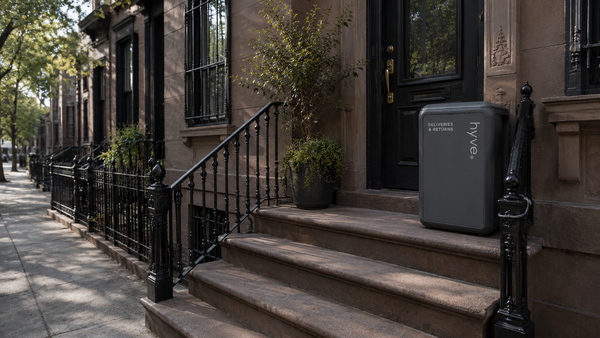
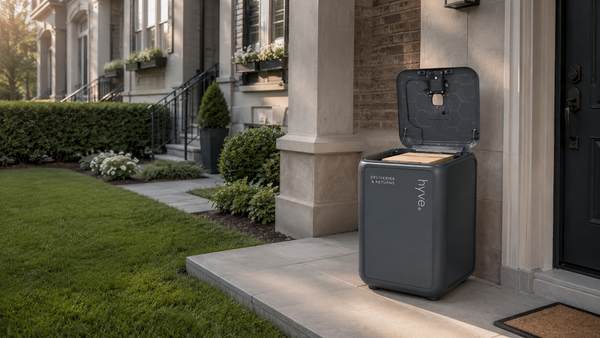
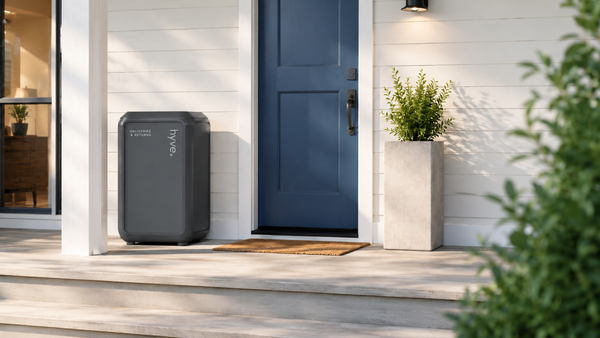
Mail got a box a century ago. Packages never did. The fix for the porch gap isn't a faster van or a smarter camera — it's giving the home a secure endpoint of its own: a locked, weatherproof outdoor package box that turns "left on the porch" into "locked inside."
Why it works comes straight from how theft actually happens. Porch piracy is a curbside crime of opportunity — thieves take what they can see and reach fast.
| Video analysis of porch-piracy incidents | |
|---|---|
| Stolen packages visible from the street | 98% |
| Located within 25 ft of the curb | 61% |
| Stolen more than 51 ft from the road | 0% |
Source: Red Stag Fulfillment, 2026.
A locked box removes every variable that makes a package stealable at once: it's no longer visible, no longer reachable, no longer sitting in the open. The opportunity simply disappears. And because a hyve box is held in place by a universal security tether and triggers a motion-triggered siren if moved, the box itself isn't the target either.

How drivers access a home package locker
The obvious objection: if the box is locked, how does the driver get in? The answer has to work on day one, for a driver who has never heard of your box and won't download anything. hyve does it with a unique vendor PIN per carrier. You generate the codes once in the app and paste each into that carrier's "delivery instructions" field — the same field you'd use for a gate code. About 30 seconds per app, then you're done.
From then on it just works. The driver reads the instruction, enters the code, the box opens, the package goes in, the lid locks. No driver app, no account, no friction. Set it once. Order like normal.
How the same secure endpoint can support returns
A locked box that only receives is half a solution. The porch gap runs both directions — and returns are where every other porch box gives up. Your hyve isn't just for what arrives. It's a safe, locked spot for outbound returns to wait until pickup comes to you.
Drop the labeled return inside, lock it, and let the pickup route collect it — on a regular cadence or on demand, depending on your plan. No printer runs, no drop-off trips, no leaving a return exposed on the step hoping it survives until someone grabs it.

Why carrier-neutral access matters
Most "smart" delivery boxes are tied to one ecosystem — one retailer, one carrier, one app the driver must be running. That's fine until the other 80% of your packages show up. UPS, FedEx, USPS, Amazon, DoorDash, Instacart — no single network delivers everything you order, so a single-network box leaves the gap wide open for everyone else.
Carrier-neutral means the box belongs to the home, not to a delivery company. Any driver from any carrier can use the code-based access, so every package lands in the same secure endpoint. That's the difference between a locker that works for some of your deliveries and infrastructure that closes the gap for all of them.

What the future connected porch looks like
The industry is racing to automate the last 50 feet — robot dogs, sidewalk rovers, drones. All of it delivers a package to a spot. None of it answers the question of what secures the package once it's there. A connected porch closes that loop: a secure endpoint that knows what arrived, alerts you the instant it's locked inside, holds your returns, and speaks to every carrier at once.
Whether the last leg is walked by a driver, a robot, or a drone, the destination is the same — a box that turns "delivered" into "in your custody." That's the porch gap, closed. One box. Every carrier. Both directions.
Sources and further reading
- Boston Dynamics — Bridging the "Porch Gap"
- The Next Web — Spot as a van-to-doorstep delivery robot
- SafeWise — 2025 U.S. Package Theft Report
- Forbes Home — States With The Worst Porch Pirates
- eMarketer — FAQ on last-mile delivery, 2026
- Red Stag Fulfillment — How Many Packages Are Stolen Annually? (2026)
- Loxx Boxx — 2025 package theft statistics and USPS OIG on last-mile risk
This article is general information and reflects reporting as of July 2026.